

SafeHer Without Plastic: A Microplastics and Reproductive Health Policy Campaign
This blog post was written by Valeria Suarez Tabares, a 2026 Marine Plastics Ambassador.
Research estimates that Americans consume between 39,000 and 52,000 microplastic particles annually from food and drink alone. However, there are still gaps that remain in our understanding of their effect on human health.
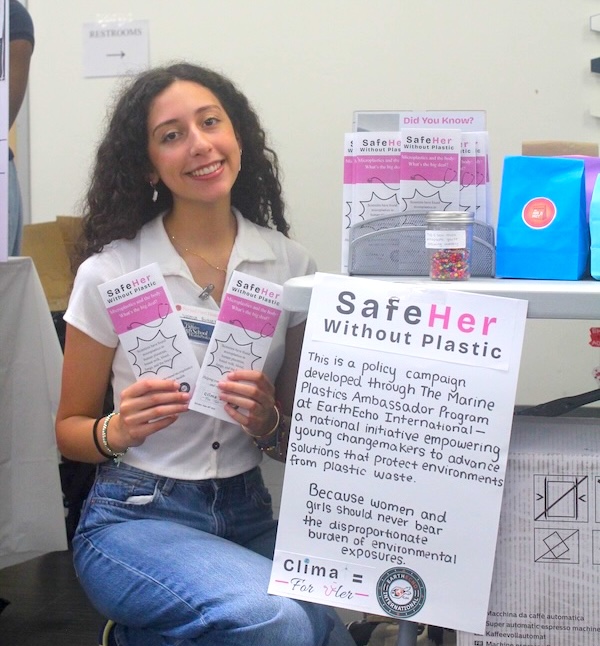
SafeHer Without Plastic is a policy campaign focused on the Microplastics Safety Act, a bipartisan federal bill that would mandate the Secretary of Health and Human Services to conduct the first formal federal study on how microplastics in food and water impact human health. I chose to approach plastic pollution through a public health lens because of its intersection with women’s health. SafeHer Without Plastic is especially focused on raising awareness about the potential reproductive health ramifications of microplastic exposure and advocating for research that guides policymakers in regulation implementation.
Throughout the campaign, SafeHer Without Plastic worked on public awareness, partnering with the Period Pact Houston to host an educational booth at the DeBakey High School for Health Professions Community Health Fair, where we distributed brochures on the importance of comprehensive microplastics research, where microplastics have been detected, and how certain chemical additives in plastic can be detrimental to human health.
Additionally, over the span of four months, we collected 180 petition signatures urging members of Congress to co-sponsor and pass the Microplastics Safety Act.
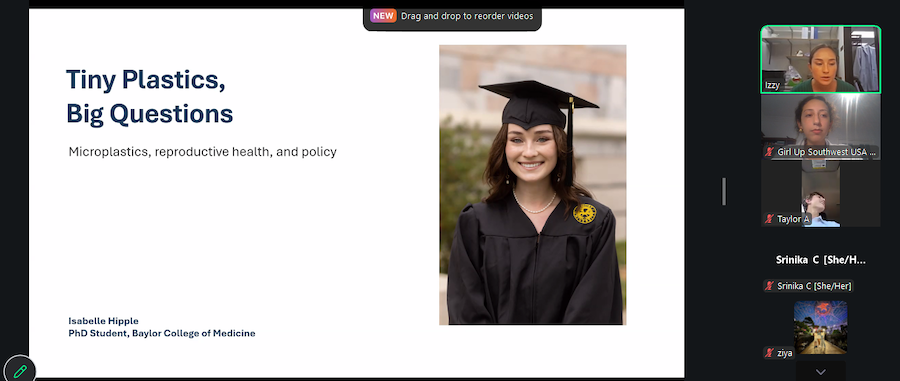
Beyond in-person events and petition signatures, we also partnered with Girl Up Southwest USA to host a webinar focused on microplastics, reproductive health, and policy. The webinar featured Isabelle Hipple, a researcher who I worked with over the summer at the Baylor College of Medicine Department of Obstetrics and Gynecology. Opportunities like these created spaces for people of all ages to learn about microplastics through a scientific perspective.
Through community outreach and digital advocacy, SafeHer Without Plastic achieved the following:
- 17,000+ people reached
- 180 petition signatures collected
- 2 events hosted with 50 attendees
- 40 brochures distributed at a community health fair
- 15,000 views on social media
- 3 partnerships developed

These are more than just numbers; they are a demonstration of the public’s interest in how pollution can threaten human health.
Being a Marine Plastics Ambassador has shifted how I approach policy advocacy. Previously, I had the notion that policy advocacy had to be direct engagement with legislators and local representatives. However, through this project, I learned that policy advocacy begins with education.
When people understand how an issue may affect their lives and community, they are provided with the tools to voice their concerns to elected officials, who then have an obligation to respond to their constituents.
Although impressive numbers can show a campaign’s reach, visibility is not all of the story. Advocacy must engender systemic change by creating public understanding and concern for a movement. Achieving 15,000 views across our campaign was a critical milestone, but recognizing the role that community engagement plays in bringing an issue to a policymaker’s attention was more important.
Although I did not have the opportunity to meet with a congressional representative, this campaign allowed me to serve my community and encourage action, which is just as important for policy change.
As SafeHer Without Plastic moves forward, I hope it will become a part of a larger movement addressing how different environmental factors can impact women’s health. Understanding this intersection requires more targeted research and policies shaped by scientific evidence.
Microplastics research is still developing. There are no current standardized methods for how to detect, quantify, or characterize microplastics and nanoplastics. Advancing reliable research methods is critical for better understanding its potential health effects, and so it is necessary for us to understand the problem before we develop solutions.
You can follow our work on Instagram at @climateforher and support the campaign by signing our petition: https://c.org/SGC5SZQKJP.
Learn more about the EarthEcho Marine Plastics Ambassadors at https://www.earthecho.org/plastics-ambassadors.