

Advancing Plastic and PFAS Awareness in Rural South Texas
This blog post was written by Alyssa Wentzel, a 2026 Marine Plastics Ambassador.
Living in the rural South Texas region, many community members and college students rely on plastic products because of their affordability, convenience, and accessibility. However, this contributes to the growing challenge of plastic pollution in the region, especially to nearby agricultural and aquatic systems. Further, these communities may be particularly vulnerable to the environmental and health impacts of plastic pollution, especially when access to environmental education, resources, and sustainable alternatives are limited. Educating students and community members is essential to increasing awareness of these impacts, empowering individuals to make informed decisions, and fostering community driven solutions. As a Ph.D. student in Environmental Engineering, I wanted to extend beyond research and increase educational outreach to the broader community and inspire the next generation of plastic pollution advocates and environmental stewards.
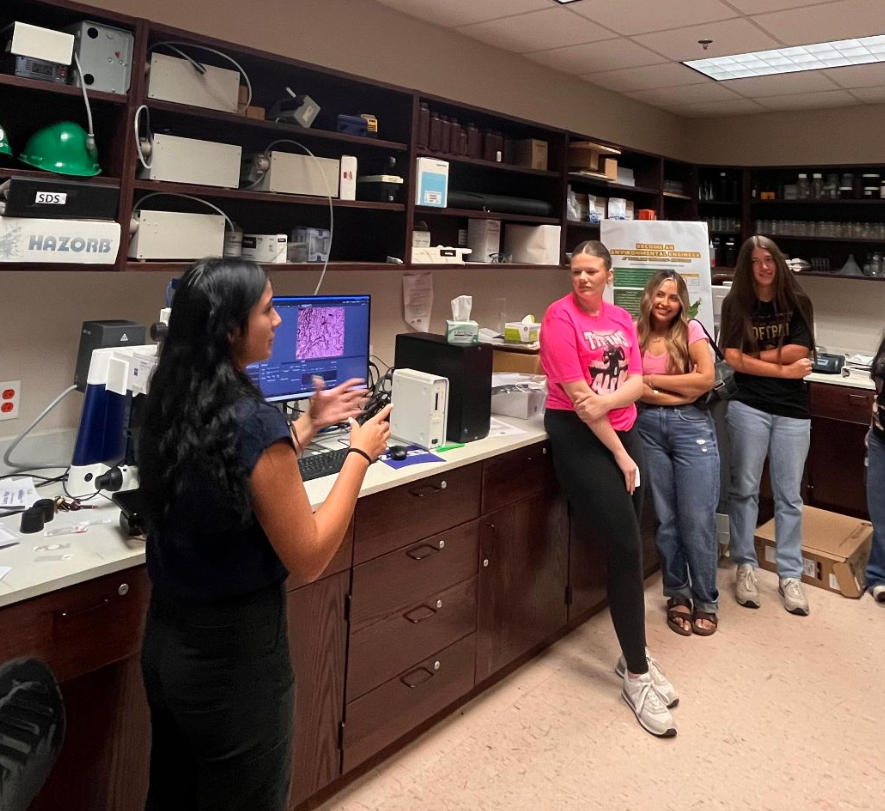
This campaign involves connecting university research to community members through organized community events, creating educational materials and demonstrations to showcase at events, and inviting local K-12 to the university to learn about plastic pollution, specifically the ongoing research of microplastics and per- and polyfluoroalkyl substances. Community events involved attending local community events, such as Bucc-days, which took place at the Corpus Christi Science Museum to engage K-5 on some of the ongoing research that the University had to offer. Specifically, I created a demonstration of how PFAS ends up into our riverways and the impacts that changes in salinity have on where it exists in the water column. This demonstration allowed users to interact with the demonstration by developing solutions of how we can remove PFAS from the environment. Our research group led five events involving high school students to learn more about microplastic pollution and how to detect it in the environment, such as coastal regions and agricultural systems. Infographics were created and distributed to the students to better understand what microplastics are and how it impacts the environment. Then students were introduced to some of the detection techniques such as Nile red staining and fluorescence microscopy.
Through the different high school outreach events, we engaged ~50-100 students from South Texas schools. Further, at the community organized events ~30-50 community members interacted with the demonstration and attended the broader event. This project would not be possible without the NSF-NRT TREAWS program and the Environmental Fate and Remediation Lab at Texas A&M University- Kingsville.
Some of the greatest successes of these outreach efforts were the strong attendance at high school outreach events and participation in organized community activities, demonstrating an interest in learning about environmental issues. However, I faced challenges in developing engaging, accessible demonstrations to explain PFAS contamination to audiences with diverse ages, backgrounds, and levels of scientific knowledge.
I plan to continue working with Texas A&M University-Kingsville and the NSF-NRT TREAWS program to attend and display educational materials at outreach events and showcase different demonstrations of how PFAS and microplastics impact the environment. Readers can follow the work our research lab does here: https://sites.google.com/view/efr-lab/outreach.
Learn more about the EarthEcho Marine Plastics Ambassadors at https://www.earthecho.org/plastics-ambassadors.