

Do You Know Your Water Well? 2026 National Water Quality Month Part 1 of 4
This blog post was authored by Alaina Dawson, EarthEcho Water Challenge Kit and Database Specialist.
Every August, National Water Quality Month is observed in the United States to highlight the importance of clean water— a vital element in human health, ecosystem protection, and the overall global need for access to safe drinking water. Water quality is the measure of water’s overall condition and can refer to multiple parameters such as temperature, clarity, and the percentage of available oxygen.
Whether you live along the coast, in the middle of a desert, or somewhere in between, your life is affected by water quality.
.JPG)
When there are negative impacts to water quality, issues may arise that lead to questions that are important to us all at some point in our lives. Because of the critical role water quality plays for all living things, it's important to ask ourselves: Is this tap water safe to drink? Will someone get sick if they swim in a local body of water? Are the fish we're catching in a nearby lake safe to eat?
To answer these questions (and more), a different question must first be asked. How do you know if your water quality is good or bad? Water quality can be tested by determining if physical, chemical and biological characteristics of a water sample measure up to a set of certain standards. Water quality can be evaluated through many different tests—some as simple as using a thermometer to find the temperature of the water, others more in depth measuring chemical components such as dissolved oxygen and acidity (pH). One of the best methods for measuring water quality and tracking trends over time is by utilizing community science. Community science, often referred to as citizen science as well, is carried out by members of the public (like you) who help collect data and contribute to the overall scientific and local knowledge of a particular subject or area. It has long been a valuable tool for increasing awareness and understanding of local water health and mobilizing community action. One example of long term water quality monitoring through community science is the South Carolina Adopt-a-Stream (SC AAS) program. This is a statewide volunteer water quality monitoring program that empowers community members to protect and improve water quality through education and certified volunteer monitoring. Data collected helps establish baseline site conditions, increases community awareness and engagement, and sparks investigation with local partners when pollution threats emerge (source: SciStarter 2026).
Through regular water quality monitoring, community scientists can help collect data used to identify trends that may be detrimental to the waterbody being tested. A network of community scientists could potentially monitor an entire watershed and assist with identifying local sources of contamination. This information could ultimately be used to reduce a community’s negative impact on local bodies of water. Sometimes, when something is negatively impacting water quality, community science can help pinpoint the source and bring about change in a positive way.
Community Science in Action
Imagine walking along a path that runs parallel to your favorite lake. This lake is close to a few new neighborhoods that have popped up in town over the past year and is easy for people to access and enjoy. The lake itself is full of life. There are dragonflies darting just over the surface, frogs settled in the sun on a lily pad, and several species of freshwater fish down in the depths. People enjoy this lake for swimming, canoeing, and even fishing.
However, you have noticed recently that there have been quite a few fish washed up and an unsightly thick, slimy layer of blue-green foam has formed along the shoreline. You begin to wonder if those two things are related somehow, and if so, what is causing the slime and what can be done to get rid of it?
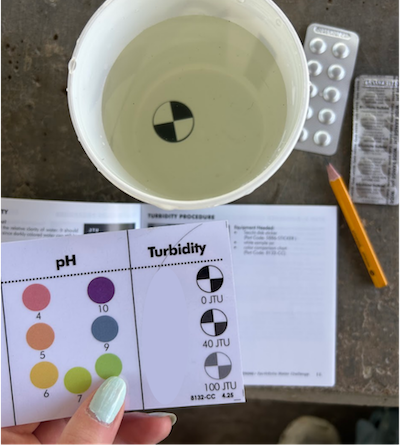
Using a water quality testing kit, you determine the dissolved oxygen of the lake is 4 parts per million (ppm). Dissolved oxygen is the amount of free oxygen molecules present in the water, or in other words the amount of oxygen that is available for fish, plants, and other aquatic life to breathe. You also learn that the range of dissolved oxygen in a healthy lake is 6 to 10 ppm, making the 4 ppm result of your water quality test quite alarming. You decide to come back each day, testing at different times and in different spots around the lake to collect additional data while also talking to others at the lake about their experiences. Through these conversations you learn that people have noticed an unpleasant odor coming from the water and that anglers have been catching less fish in the last few weeks.
Using these observations along with your own collected data, you begin to suspect that the lake is currently being affected negatively by an algal bloom – or an overabundance of organisms known as cyanobacteria that can grow quickly and use of much of the water’s oxygen. When oxygen levels are low in the water, this can create ‘dead zones’. Dead zones can lead to a reduction in fish populations because many species either die from lack of available oxygen or migrate away from the area.
Now that you know what is affecting the lake, you want to find out why.
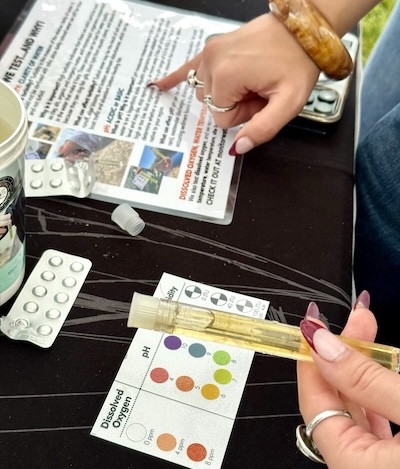
There are several reasons that algal blooms appear in both fresh and saltwater, but they often occur near industrial or residential areas where excess nutrients from fertilizers or sewage are the culprit. After considering the surroundings of the lake, you begin to wonder if the nearby neighborhoods that were recently built could be the reason behind the increase of nutrients in the water system. As suspected, everyone in these neighborhoods have beautiful yards! While most people appreciate nicely maintained grass, this can often come at an environmental cost.
Many people use fertilizers in their yard which can be high in nitrogen and run off during storms or sprinkler watering. After doing some more research, you determine that a bit of community education might go a long way.
Together with other concerned citizens, you launch a campaign to help promote slow-release, low-nitrogen fertilizers in residential yards. You also provide helpful guidelines for fertilization schedules such as watching the weather for storms, skipping application before expected application, or to fertilize after sprinklers turn off. You can learn more about responsible fertilization practices here.
Through door-to-door canvassing, community town halls, and word of mouth, many residents change their lawn management routines and slowly the algal bloom disappears from the lake. After a few months, you head to the lake with your water quality testing kit once again, discovering that the dissolved oxygen level of the water is now at a much healthier level of 7 ppm.
Implementing Successful Community Science
This is just one example of how water quality can be impacted by outside influences and how, through community science and engagement, solutions can often be easily found and applied. Clean water is important for the health of the environment, wildlife, and people.
If you would like to become a citizen scientist and help make a positive impact in your local community through water testing, you can now order directly through the EarthEcho Water Testing Kit Shopify page.
These kits are easy to use for any age and level of familiarity with water quality testing.
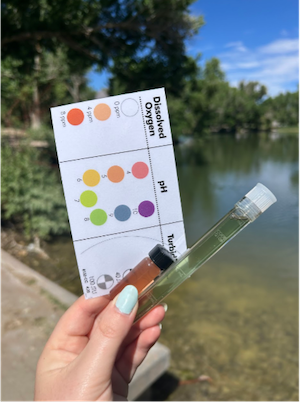
Learn more about the EarthEcho Water Challenge—a program that equips youth to become community scientists through local water quality testing—you can find more information by visiting https://www.monitorwater.org/
Here you will find information on important monitoring dates (such as World Water Monitoring Day on September 18th each year), news from community scientists around the world participating in the EarthEcho Water Challenge, and resources on how and why to participate in the EarthEcho Water Challenge yourself!
If you already have some water quality data that you would like to add to EarthEcho’s global database, more information on that process can be found here: https://www.monitorwater.org/resources/submit-your-data
This month we offer four blog posts that explain the role of water quality through the lens of water policy, biodiversity and blue carbon ecosystems, marine plastics and debris, and learning about your local water quality. Stay tuned for additional articles on the importance of water quality.